A journey through the Body systems
Science
This year I have grown in my understanding of the body’s systems.
There are three main systems in the body, the circulatory system, the respiratory system, and the digestive system. The digestive system is exactly as the name suggests, the system that is digesting the food as you eat it. Part of the digestive system is mechanical digestion, when you are chewing the food.
During the process of mechanical digestion, your teeth, tongue, and cheeks break down the food. Then the salivary amylase (saliva) chemically break down the glucose molecules in your food. Next, the molecules in your tongue will push the food down the esophagus. The food enters the stomach through the esophageal sphincter, where acids in the stomach digest the food into chyme. Now in the intestines, the chyme travels through the small intestines. The nutrients are absorbed through the villi. The nutrients are now so small that they are taken through the villi to the capillaries, then fats are digested in the small intestine.
The respiratory system is where oxygen, nitrogen, and carbon dioxide enter your body through either your mouth or your nose. From your nose of mouth, the oxygen (and other gasses) pass the epiglottis and move down the trachea (the epiglottis covers the trachea to keep food from entering your lungs). After the trachea, the oxygen enters your lungs. The oxygen fills little "sacks" in your lungs called the alveoli. Your alveoli are covered in capillaries and the oxygen will go into the capillaries through the process of diffusion.
Diffusion; the process in which a substance moves from high to low concentration, a cell membrane may be present.
When glucose and oxygen are in the blood stream together, they create a chemical reaction known as cellular respiration, which has a product of energy. Your red blood cells, which travel in your blood stream, carry the glucose and oxygen with them as they are pumped through the heart and all the cells. The plasma in your blood carries things like water, nutrients, and waste products (the circulatory system).
As a matter of fact, your left lung is smaller than your right lung to make room for your heart.
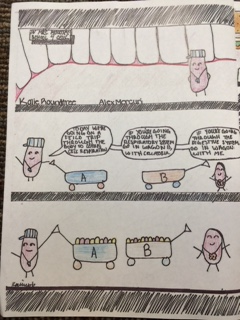
In Science we did a project that I think really helped demonstrate my understandings. The "How and why does my body use food?" project. We got to choose a way to talk about this topic whether it was a story book, a comic strip, a chart, model, etc.
My partner Kalie and I chose to do a comic book about Mrs. Mouths school for cells, and it taught the little cells all about the body's systems and functions. In the images above you can see our comic book. The comic book is where we took all of our new content and made the product.
Again, in the images above you can also see a screen capture of some emails that my partner and I sent to each other while we were unable to communicate in person while working on our project. This shows how we used our technology and resources to help advocate for ourselves when we were struggling.